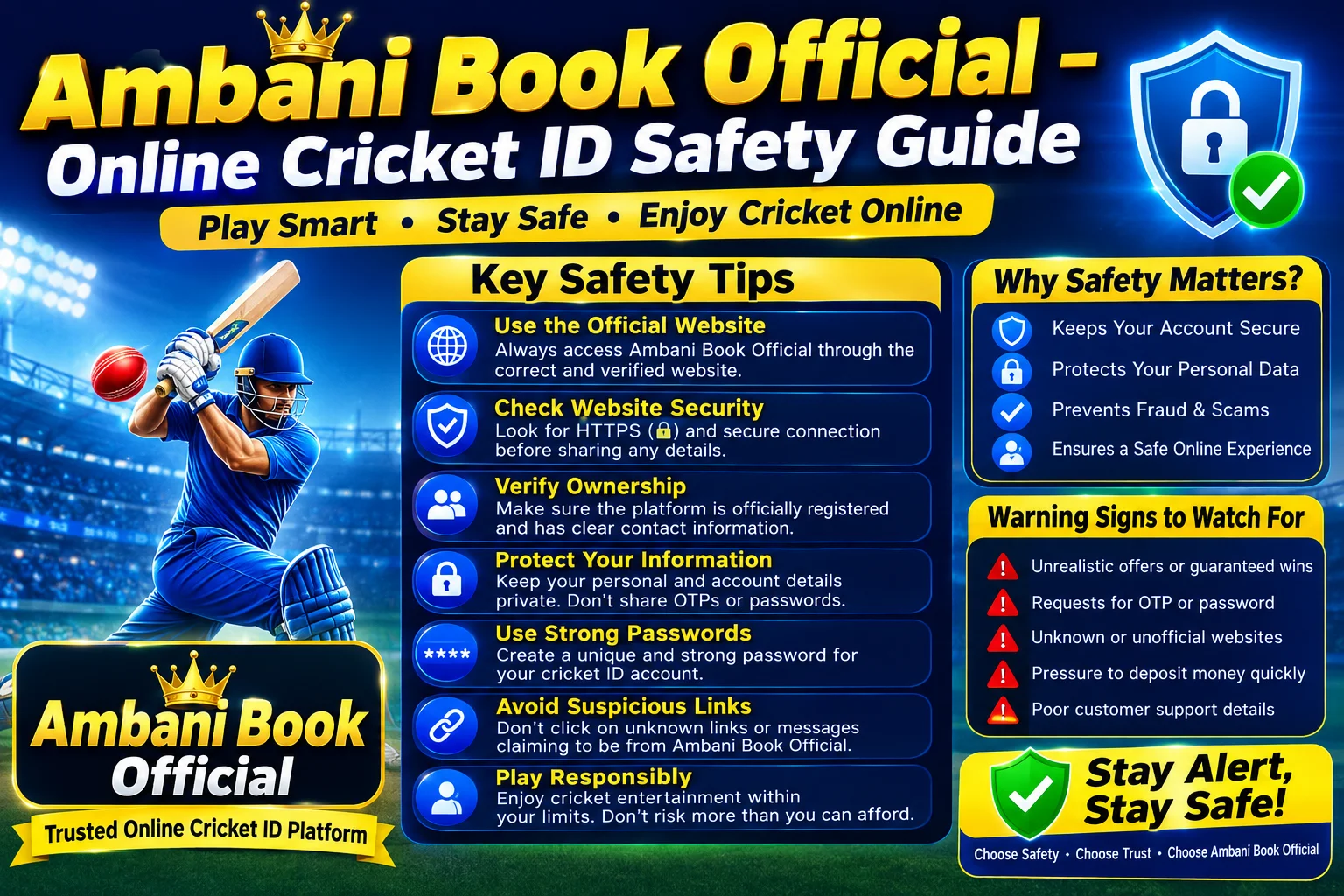
Ambani Book Official – Online Cricket ID Safety Guide: 7 Essential Checks
Ambani Book Official is discussed here from a neutral safety perspective, covering online cricket ID verification, legality, account security, responsible use, and important checks before using any online platform.
Comprehensive Outline
| Section | Topic Covered |
|---|---|
| 1 | Introduction to online cricket platforms |
| 2 | What an online cricket ID means |
| 3 | Why platform verification matters |
| 4 | Checking legal availability |
| 5 | Understanding account registration |
| 6 | Protecting personal information |
| 7 | Recognizing misleading websites |
| 8 | Secure login practices |
| 9 | Understanding payment risks |
| 10 | Responsible participation |
| 11 | Common warning signs |
| 12 | Comparing platform information |
| 13 | Mobile security considerations |
| 14 | Customer-support checks |
| 15 | Frequently asked questions |
| 16 | Conclusion |
Introduction
Online cricket platforms have become increasingly visible as cricket fans look for digital services connected with matches, scores, statistics, entertainment, and, in some cases, wagering. However, not every website using terms such as “Ambani Book Official,” “online cricket ID,” or “cricket account” should automatically be considered trustworthy.
Before creating an account or sharing personal information, users should take a careful look at the service behind a website. A professional-looking homepage doesn’t necessarily prove that a platform is legitimate, licensed, or safe.
That’s why this guide focuses on verification and user safety rather than promoting any particular betting service. If you’re researching an online cricket ID platform, the goal should be to understand who operates it, what rules apply where you live, how your information is handled, and what risks may exist.
The same principle applies to any online service: don’t rush simply because a website promises quick registration or easy access. A few minutes of checking can prevent much bigger problems later.
What Is an Online Cricket ID?
An online cricket ID generally refers to an account or login credential used to access a cricket-related digital service. Depending on the platform, the account could provide access to match information, statistics, entertainment features, or wagering-related services.
The exact meaning of an “ID” varies between websites. Some services may use an email address or phone number, while others may issue a separate username and password.
Users shouldn’t assume that every cricket ID works in the same way.
Before registering, check:
- What service the account actually provides.
- Who operates the website.
- Whether the operator identifies itself clearly.
- What information is required during registration.
- Whether the service is legally available in your location.
- What privacy policy applies to your information.
- Whether there are age restrictions.
- What customer-support channels are available.
These checks are especially important when a website involves financial transactions.
Why Verification Matters
Online identity and account security have become major concerns across the internet. Cricket-related websites are no exception.
A website may use professional graphics, familiar cricket terminology, promotional language, or a recognizable brand-style name. None of those things independently establish authenticity.
A safer approach is to verify the underlying operator.
Look for a clearly identified company or organization, a physical or registered business address where appropriate, terms and conditions, privacy information, and transparent contact details.
If those details are missing, inconsistent, or difficult to verify, that’s a reason to pause.
Check the Website Address Carefully
One common problem is imitation websites. A fraudulent website may use a domain name that looks similar to a legitimate service.
Check the spelling carefully. Watch for:
- Extra words.
- Unusual characters.
- Misspellings.
- Suspicious redirects.
- Domains that frequently change.
- Pages that ask for unnecessary personal information.
A padlock or HTTPS connection is useful because it indicates encrypted communication, but HTTPS alone doesn’t prove that a website is legitimate.
Check the Legal Position First
The legality of online gambling and betting services can vary substantially by jurisdiction. Users shouldn’t assume that because a service is accessible online, it is automatically lawful where they live.
In India, laws and regulatory treatment can differ depending on the activity and jurisdiction, and the legal environment can change. Therefore, anyone considering a wagering-related service should consult current official legal information applicable to their own location.
For general information about Indian government services and legislation, users can consult the Government of India portal and relevant official government or state-government sources.
A website’s own statement that it is “legal” shouldn’t be treated as independent proof.
Registration: What Should You Check?
Registration should be approached carefully.
A legitimate service should explain why it needs particular information and how that information will be used. Users should be cautious when a website requests excessive information without providing a clear explanation.
Before submitting registration details, review:
- The site’s privacy policy.
- Its terms of service.
- Age requirements.
- Account restrictions.
- Data-storage practices.
- Withdrawal or transaction terms, if applicable.
- Customer-support information.
Never provide passwords, one-time authentication codes, or banking credentials to someone claiming to be an account representative through an unofficial messaging channel.
Protect Your Personal Information
Personal information has value. Phone numbers, email addresses, identification documents, passwords, and financial information can all create security risks if handled improperly.
Use a unique password for each important account. A password manager can make this easier.
Where available, enable multi-factor authentication.
Also avoid sending sensitive documents through informal channels unless you’ve independently verified the recipient and the platform’s requirements.
Information You Should Treat as Sensitive
Be especially careful with:
- Passwords.
- One-time passwords.
- Banking PINs.
- Card security codes.
- Government identification numbers.
- Full banking details.
- Recovery codes.
- Authentication-app codes.
A genuine customer-support representative should not need your password or one-time authentication code.
Recognizing Suspicious Websites
There are several warning signs that deserve attention.
Guaranteed Returns
Claims that users can receive guaranteed profits are a major warning sign. Financial outcomes cannot legitimately be guaranteed simply because a website says they are.
Pressure to Deposit Quickly
Messages such as “deposit now,” “limited-time account,” or “act immediately” are designed to encourage rushed decisions.
Take a step back instead.
Unclear Ownership
If you cannot determine who operates a website, be cautious about giving it money or personal information.
Unverified Testimonials
Testimonials can be fabricated, selectively presented, or difficult to verify. Don’t rely on testimonials alone when assessing an online platform.
Constantly Changing Domains
Frequent domain changes can make it difficult for users to establish which website is genuine. This is another reason to independently verify the operator.
Secure Login Practices
Account security begins with the user.
Create a strong, unique password that isn’t reused elsewhere. Avoid using obvious information such as your name, birthday, phone number, or common words.
If a platform supports multi-factor authentication, enable it.
Never save passwords on shared computers.
When using a public computer, don’t allow the browser to save your login credentials.
After finishing your session, log out.
These habits may sound basic, but they can make a substantial difference.
Understanding Payment Risks
Any online service involving deposits, withdrawals, or other financial transactions deserves additional scrutiny.
Before making a transaction, users should understand:
- Who receives the money.
- What payment methods are supported.
- Whether fees apply.
- What transaction limits exist.
- What verification may be required.
- What happens if a transaction fails.
- How disputes are handled.
Don’t send money to a personal bank account simply because somebody claims to represent a website.
Similarly, don’t share banking passwords, OTPs, or PINs with another person.
If a transaction appears suspicious, contact the relevant financial institution through its official communication channel.
Responsible Participation
For services involving wagering, responsible participation is essential.
Betting should never be treated as a guaranteed income source or a replacement for employment or savings.
Users should establish clear personal limits and avoid chasing losses.
A loss doesn’t become more likely to disappear simply because someone continues spending money to recover it.
Warning signs of unhealthy behavior can include:
- Spending more than intended.
- Trying to recover losses immediately.
- Borrowing money to continue.
- Hiding activity from family members.
- Feeling unable to stop.
- Spending money intended for essential expenses.
If any of these situations occur, stepping away from the activity is a sensible choice.
Comparing Online Cricket Platforms
If you’re researching several cricket-related websites, don’t compare them only by promotional offers.
Instead, build a simple evaluation framework.
| Factor | What to Look For |
|---|---|
| Operator | Clearly identified organization |
| Legal status | Applicable rules and licensing information |
| Privacy | Transparent privacy policy |
| Security | HTTPS and secure authentication |
| Support | Verifiable customer-service channels |
| Terms | Clear and accessible conditions |
| Payments | Transparent transaction information |
| Reputation | Independent and credible sources |
| Age restrictions | Clearly stated requirements |
| Responsible-use tools | Limits, self-exclusion, or similar controls |
This approach gives you a more balanced picture.
Mobile Security Considerations
Many users access cricket websites from smartphones. Mobile convenience, however, doesn’t eliminate security concerns.
Avoid installing applications from unknown sources simply because a website recommends them.
Use official app stores whenever possible, keep your operating system updated, and review application permissions.
Be cautious if an application requests access that doesn’t appear necessary for its stated purpose.
For example, an ordinary informational cricket application shouldn’t automatically need unrestricted access to unrelated personal information.
Beware of Fake Ambani Book Official Customer Support
Customer-support impersonation is another common online risk.
Someone may contact you through a messaging application and claim to be an account manager, technical representative, or payment specialist.
Don’t trust the person simply because they know your username.
Instead:
- Leave the conversation.
- Open the official website independently.
- Find the published support channel.
- Contact support through that channel.
- Never disclose passwords or OTPs.
This small habit can prevent many account-takeover attempts.
How to Evaluate “Ambani Book Official” Searches
When users search for phrases such as “Ambani Book Official,” they should first determine what the search result actually represents.
Search-engine visibility isn’t the same as verification.
A result appearing near the top of a search engine doesn’t necessarily mean that the website is officially connected to a particular organization, person, or brand.
Check the site’s ownership claims independently.
Also be cautious of pages that use famous names merely to attract attention. A brand-like name doesn’t establish a legal relationship with a well-known company or individual.
Avoiding Misleading Promotions
Promotional language can make an online service appear safer than it really is.
Words such as “official,” “trusted,” “guaranteed,” “instant,” and “secure” are claims that should be evaluated rather than accepted automatically.
A better approach is evidence-based verification.
Ask:
Who operates it?
Where is the operator registered?
What laws apply?
How is user information protected?
What happens when something goes wrong?
Can the company’s claims be independently verified?
If the answers aren’t clear, don’t rush into registration or financial transactions.
What To Do If You Suspect Fraud
If you believe you’ve provided information to a fraudulent website, act quickly.
Change passwords that may have been exposed, especially if the same password was used elsewhere.
If financial information may have been compromised, contact your bank or payment provider through its official channel.
Preserve relevant evidence such as transaction records, emails, screenshots, and website addresses.
Don’t send additional money because someone promises to recover previous losses.
Recovery scams often target people who have already experienced fraud.
Building Better Online Habits
Online safety isn’t about avoiding every digital service. It’s about making informed decisions.
A useful habit is the pause-and-check method:
Pause: Don’t act because a message creates urgency.
Check: Verify the operator and website independently.
Read: Review terms, privacy information, and transaction conditions.
Protect: Keep passwords and authentication information private.
Decide: Only proceed when you understand the risks and legal position.
This method works beyond cricket websites. It can also help when evaluating shopping sites, financial services, social-media offers, and unfamiliar applications.
Frequently Asked Questions
1. What is an online cricket ID?
An Ambani Book online cricket ID is generally an account or login credential used to access a cricket-related digital service. The exact features depend on the provider.
2. Is every website using “Ambani Book Official” in its name genuine?
No. A Ambani Book Official website calling itself “official” doesn’t independently prove that it is authentic or authorized. Ownership should be verified through reliable sources.
3. Is online cricket betting legal everywhere in India?
No blanket assumption should be made. The applicable legal position can depend on the type of activity and jurisdiction. Users should check current official information relevant to their location.
4. Should I share an OTP with customer support?
No. One-time authentication codes should be treated as confidential. Don’t disclose them to another person claiming to be support.
5. Does HTTPS mean a website is trustworthy?
Not necessarily. HTTPS encrypts communication between your browser and the website, but it doesn’t by itself establish that the website operator is legitimate.
6. How can I identify a suspicious cricket website?
Look for unclear ownership, unrealistic promises, pressure to deposit money, unusual domains, weak contact information, and requests for sensitive information through unofficial channels.
7. Should betting be considered a source of income?
No. Wagering involves financial risk and shouldn’t be presented as guaranteed income or a substitute for regular earnings.
8. What should I do if I think an online platform is fraudulent?
Stop sending money or information, secure affected accounts, contact your bank or payment provider if necessary, preserve evidence, and report suspected fraud through appropriate official channels.
Conclusion
Searching for Ambani Book Official or an online cricket ID platform should begin with verification rather than promotion.
A professional appearance, positive testimonial, or high search ranking isn’t enough to establish that a website is legitimate. Users should investigate the operator, understand the applicable legal framework, protect personal information, and carefully review financial conditions.
For wagering-related services, responsible participation is equally important. Never treat gambling as guaranteed income, and don’t chase losses or use essential funds for risky activity.
Ultimately, the smartest online decision is an informed one. Take your time, verify independently, protect your credentials, and walk away from any service that doesn’t provide clear and credible answers.
Important note: This article is intended for general information and online-safety education. It does not endorse, advertise, or recommend any particular betting or gambling service. Laws and regulations can change, so readers should consult current official information applicable to their jurisdiction.
Ambani Book ID, Ambani Online Book, Go Ambani, Go Ambani99, Go Ambani ID, AmbaniExch99